
CONTACT YOUR REPRESENTATIVES:
HERE ARE PENDING BILLS VITAL INTENDED TO END THE TRAGIC FATE OF OUR HORSES:
S. 311 & HR 503 to amend the Horse Protection Act to prohibit the shipping, transporting, moving, delivering, receiving, possessing, purchasing, selling, or donation of horses and other equines to be slaughtered for human consumption, and for other purposes . These bills have been lingering for years in the house and the senate waiting to get enough co-sponsors. Naturally, this is not a priority, so it is up to animal caring people, especially horse activists to keep calling/writing to their reps and ask him/her to support these bills. Meanwhile, a third bill has been introduced by Senator Mary L. Landrieu of Louisiana: S. 1176 American Horse Slaughter Prevention Act of 2011 by (A bill to amend the Horse Protection Act to prohibit the shipping, transporting, moving, delivering, receiving, possessing, purchasing, selling, or donation of horses and other equines to be slaughtered for human consumption, and for other purposes). It is difficult to guess which of these bills will move forward to eventually become law, thus, ask your reps to support all of them. Hopefully, one of these bills will successfully become law, during this century.
Until this happen, please do not wait around but join the anti-horse slaughter activism. In order to help end the atrocities at least to the horses sent to Mexico, we are working together with the Mexican animal protection group and other groups worldwide, calling for demos at Mexican embassies and consulates around the world. Our primary goal is to have the Mexican government shut down San Barnabe, the most hellish place a horse could be sent to.
US CITIZENS: CONTACT YOUR REPRESENTATIVES:


Horse slaughter evokes outrage Web Posted: 10/02/2007 03:19 AM CDT
Lisa Sandberg
Express-News Austin Bureau
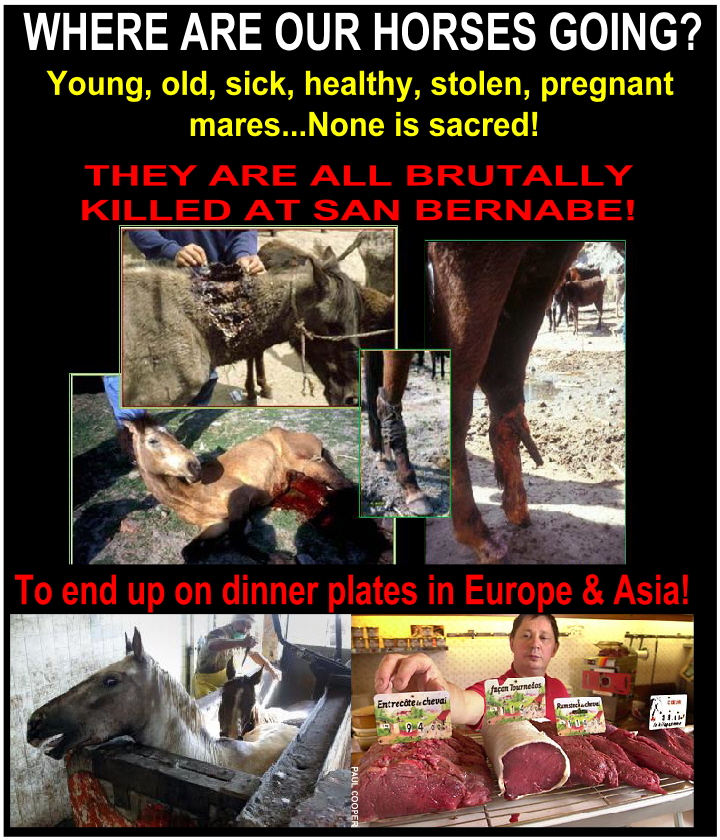
AUSTIN — A surge in exports of unwanted horses across the border for slaughter has horrified animal welfare advocates, who say they will redouble efforts for a law to ban shipments of horses to Mexican and Canadian slaughterhouses. Court rulings this year closed the only three American horse-slaughter plants, including two plants in North Texas. Since January, so-called "killer buyers" who buy unwanted horses at auctions have shipped 48,000 horses to Canada and Mexico for slaughter. The horse meat is
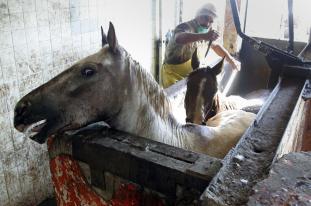
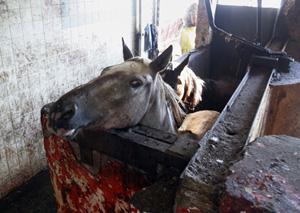
consumed in Mexico, Europe and Japan. U.S. exports to Mexican slaughterhouses are up by 369 percent. The San Antonio Express-News on Sunday chronicled the crude method used to kill horses at a plant in Juárez, Mexico, where slaughterhouse workers stab horses in the spine until they are disabled. Horses are then strung up from a hind leg and their throats are slit.
The grim story prompted outrage from activists and congressmen who have tried to ban slaughter through the Horse Protection Act.
"If members of Congress saw these photos and read the story, I think we'd get some immediate action," said U.S. Rep. Charlie Gonzalez, D-San Antonio, a horse slaughter opponent.
But given the current debates in Congress today — children's health insurance, the war in Iraq — Gonzalez said he doesn't think the federal ban, which would protect American horses from commercial slaughter, here and across U.S. borders, will be a priority.
U.S. Rep. Gene Green, a Houston Democrat who opposes horse slaughter, said he's received neither calls nor e-mails from constituents since the proposed ban was reintroduced earlier this year. The same bill died in Congress last year. Readers expressed mostly horror upon learning that the closure this year of U.S. horse slaughter operations hasn't spared American horses from winding up as foreign entrees. More than 100,000 U.S. horses were slaughtered last year for overseas dinner plates, according to government figures. About 15,000 fewer horses overall have been slaughtered this year, but exports to the foreign
slaughterhouses are way up.
Sunday's newspaper report documented conditions at a municipal plant in Juárez, where horses were hacked to death with knives, rather than stunned with the captive bolt guns that were common at U.S. plants. The "puntilla" method appears to be standard at older slaughter plants throughout Mexico.
"Thank you for bringing this atrocity to the front page," one reader wrote. "I want to know what I, as an individual and animal lover, can do to end this horrible practice?"
Those who lobbied unsuccessfully to keep horse slaughter plants open in the U.S. say they warned their opponents that horses would suffer far more if the plants were closed and they were exported. It's predictable," said former U.S. Rep. Charlie Stenholm, who went to work as a lobbyist for the horse slaughter industry after losing his seat in Congress and now is a spokesman for the Horse Welfare Association. Stenholm said he agreed with animal welfare advocates that there is no easy way to kill a horse.
"If you're going to prematurely end a horse's life, it's going to be difficult. No matter what," he said. "Nothing is perfect, but the captive bolt gun is the best of all options."
Animal advocates say the killing method and the conditions horses endure as they are shipped across the country should not be used as an argument to reopen American slaughter operations. The solution, they say, is to ban horses from being slaughtered in this country — or exported and killed in Mexico and Canada. Operations ceased at the U.S. slaughterhouses after various courts upheld state bans in Texas and Illinois. "The urgency is in passing the federal legislation," said Chris Heyde, deputy legislative director with the Animal Welfare Institute in Virginia. "Until we pass the federal legislation, nothing has changed." Advocates argue that horses should be spared from slaughter because they've become more like companion animals, like cats and dogs, and have played an important role in U.S. history. They also contend that commercial slaughter was cruel even when done in this country. Because they tend to move around a lot, have narrow foreheads and brains set farther back in their skull than cows, horses sometimes have to be hit multiple times with a captive bolt gun before dying. Said Gonzalez: "I don't have a perfect solution to the problem, but I do know that slaughtering horses for the retail market goes totally contrary to the values established in this country. It's why we don't eat horse meat."
--------------------------------------------------------------------------------
lsandberg@express-news.net
News Researcher Julie Domel contributed to this report.
YOU COULD BE EATING UNSAFE HORSE MEAT!
Horses, unlike traditional food animals in the United States, are not raised or medicated during their lifetime with the intent of one day becoming human food. Because no American horse is ever "intended" for the human food chain, often times horses throughout their lives will have received medications that are banned for use ever during the life of food animals. Click here for list of drugs prohibited for use in horses slaughtered for human consumption. Additionally, medications which are FDA approved for use in traditional food animals come with very specific withdrawal schedules printed on the packaging, whereas, the very same medications, for example-- dewormers, when purchased for horses do not include the requisite food animal withdrawal schedule, but simply state "NOT FOR USE IN HORSES INTENDED FOR FOOD".
LEARN MORE >>>>>>> http://www.vetsforequinewelfare.org/medications.php

MORE ON DRUGS: Prime consumers of horsemeat -- at $15 to $20 a pound -- are the French and Japanese. They, and other consuming nations (Italy, Holland, Belgium, Switzerland, etc.), should be aware that much of the American horseflesh they are chowing down may be carcinogenic. The reason is a powerful pain-killing drug called phenylbutazone, or "bute" as it is commonly called from racetracks to ranches. Phenylbutazone is a known carcinogen -- an agent capable of causing cancer -- as determined by the federal government's National Toxicology Program. Bute is a non-steroidal anti-inflammatory drug that horsemen use for pain relief and fever-reducing purposes -- treating muscular sprains and strains, muscle fatigue and overuse, tendonitis, and arthritis in their animals. Because it works directly on the inflamed tissue and allows the horse a free range of motion without pain, it is immensely popular for use by horse owners. Read more >>>>> http://www.niagarafallsreporter.com/hanchette182.html
YOUTUBE: OUR DEMO AT THE MEXICAN EMBASSY, DC
US HORSES ESCAPED THE SLAUGHTERHOUSES IN THIS COUNTRY ONLY TO
MEET THE MOST HORRIFIC DEATHS IN MEXICO'S SAN BERNABE...
------------------------------------------------------------------------------
Here's what ASPASDEMEXICO have to say about San Barnabe: http://www.apasdemexico.org
"The Market of San Bernabe, in the city of Almoloya de Juarez, in the State of Mexico, is one of the most outrageous examples of brutality and violations to health legislation in Mexico. While Mexican federal and local government institutions are thoroughly entitled to carry out inspection and monitoring visits, and could therefore solve this problem, they have been thus far totally apathetic. Traffic of species, dirt, and tremendous cruelty are the daily scenario. This case has been broadcasted through national TV news and special reports, so authorities cannot pretend to be unaware of it.
Here, the so-called work, consumption, and company animals are sold ? horses, donkeys, and even dogs?, as well as wild species of doubtful origin. Many of them are visibly sick; they are shipped in and out in awful conditions; they are sadistically dragged, in spite of having exposed fractures, bleeding, and/or sores. One can see also animals that are suspended with ropes within trucks as they are too weak to remain standing, and when these agonizing creatures die they are immediately cut open and their entrails are thrown all over. These so-called "disposable animals" are kept alive just because the cost of a kilo of living meat is almost twice the kilo of dead meat. A dantean scenario of violence and dirt, where laws are not enforced and authorities are totally absent. After a lifetime of forced labor, horses are discarded and sold at the Mercado de San Barnabe where they are slaughtered in the most barbarian manner. This is where American horses are being sent to be killed."
To familiarize yourself with this most disturbing barbarism, here are a few links:
WHAT YOU CAN DO
PLEASE TAKE ACTION FOR THE HORSES!

TRAVELING TO MEXICO?
