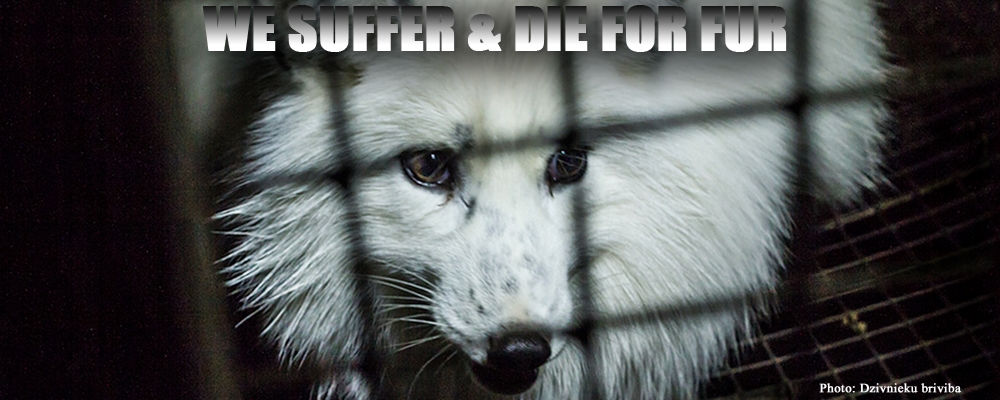
Fur animals in China suffer one of the most cruel and savage practices ever heard against defenseless beings. The hideous cruelty is hidden from consumers who may not know that each fur article comes with an unimaginable amount of agony. All this in the name of fashion.
The shocking footage from a recent investigation into the Chinese dog and cat fur industry reveals the slaughter of millions of dogs and cats that are bludgeoned, hanged, bled to death, and strangled with wire nooses so that their fur can be turned into trim and trinkets. Their fur is often mislabeled as that of other animals and exported into the United States, the European Union, and other countries, where it may be sold to unsuspecting customers.
BEWARE OF FALSE LABELS:
Dog and cat fur is often falsely labeled to obscure the true source of the fur. Dog fur products have been sold as Gae-wolf, Asian wolf, Asiatic raccoon, China wolf, Corsac fox, Goupee, Pommern wolf, Loup d'Asie, Asian jackal, Dogue de Chine, Sobakigae-wolf, Mongolian dog fur, and Asiatic racoon, Mountain Goat skin, Sakon Makhon lamb, Kou pi, Dog skin plasters (sold in Chinatowns as a cure for rheumatism). Cat fur has been sold as Housecat, Wild cat, Katzenfelle, Goyangi, Mountain cat, rabbit, maopee, gatto cinesi, natuerliches mittel, and chat de Chine. Fur manufacturers in China told HSUS investigators they could sew any label they asked for onto dog and cat fur products to make them more marketable.
Since 1997, The Humane Society of the United States (HSUS) has investigated and documented the international trade in dog and cat fur and skins. This undercover investigation has spanned the globe from source countries in China, the Philippines, and Thailand to retailers and wholesalers in the United States, Russia, and the European Union.
Over two million dogs and cats are slaughtered each year for their furs and skins, mostly in China and other Asian countries. Investigators documented 50,000 to 100,000 cat pelts stockpiled at animal byproduct factories in China. At least ten dogs are slaughtered to make a single coat – more if puppies are used. Up to 24 cats are slaughtered to make one fur coat. Dog and cat fur is used in trims, linings, hats, decorative figurines, and folk remedies. Skins are used in dog chew toys and shoe leather.
The slaughter of these animals is violent and pitiless. Cats are strangled inside their cages as other cats look on. Dogs are noosed about the neck by metal wires, and then slashed across the groin. The wire noose cuts into their throats as they struggle in pain before finally losing consciousness. In Harbin China, HSUS investigators documented a German shepherd still blinking and conscious as he was being skinned. At a dog farm several hours north of Harbin, investigators documented dead dogs hanging from hooks as others, still alive, awaited their fate outside the same cold, dismal room.
An investigator from Swiss Animals Protection/East International said: "Conditions on Chinese fur farms make a mockery of the most elementary animal welfare standards...In their lives and their unspeakable deaths, these animals have been denied even the simplest acts of kindness."
A LIFE OF MISERY BEFORE THEIR BRUTAL DEATH:
Fur-bearing animals are killed by gassing, neck breaking, anal electrocution, clubbing, trapping and injection with poisons so as not to damage their pelts. These animals live horrendous existences when they are "ranch-raised" on a "fur farm", or are brutally killed in the hands of trappers. On ranches, they spend their entire lives in tiny, filthy cages and suffer tremendously, many become deranged until they meet with brutal deaths. The U.S. produces about 10% of the cage-raised fur in the world; 60 to 75% of the fur in coats sold in the U.S. comes from cage-raised animals, and 90% of cage-raised foxes are used in fur-trim. (HSUS 2004). Trapping is another incredibly cruel method used on fur bearing animals. Check this link to learn more: http://www.bancrueltraps.com/f1_cull_about.php
HOW DOES THE DOG & CAT FUR ISSUE AFFECTS US?
Although cat/dog fur has been banned in the U.S., amendments made to the U.S. Fur Products Labeling Act exempt all fur products costing less than $150 from labeling requirements, a price range into which most fur-trimmed garments and accessories fall. Consequently, it is essentially impossible to know if one is buying a cat or dog fur trimmed item, unless DNA tests are conducted. The price of a DNA test starts at $500.
Until this loophole is completely closed, one never knows how many dog and cat pelts are making it into the lives of unsuspecting citizens. Please write to your Reps in Congress and ask them to vote to close this loophole. Find your reps here: http://www.congress.org/congressorg/home/